

Evaluating J.T. Realmuto's new contract
When the Phillies acquired J.T. Realmuto in February 2019, in exchange for three players, including catcher Jorge Alfaro and top pitching prospect Sixto Sanchez, it signaled the end of a nearly decade-long rebuilding phase.
Realmuto’s 9.3 fWAR over the previous two seasons led all MLB catchers. The Phillies seemed to have their long-term answer at catcher that they’d been lacking since Carlos Ruiz was traded to the Dodgers two-and-a-half years before. They looked ready to be a legitimate contender again for the first time since 2011.
But after the Phillies slugged through underwhelming 2019 and 2020 seasons, a Realmuto extension did not happen. With the Phillies’ murky front office structure for most of the offseason after demoting GM Matt Klentak combined with the financial challenges as a result of the COVID-19 pandemic, it seemed for many weeks that Realmuto’s tenure in Philadelphia was over.
After a social media barrage from the entire fanbase, a year-long campaign from Bryce Harper and a “#SignJT” tweet from Archie Bradley less than two hours after he signed with the Phillies, new President of Baseball Operations, Dave Dombrowski got it done.
Over 700 days following Realmuto’s arrival in Philadelphia, the Phillies have locked up Realmuto for the foreseeable future.
Realmuto’s deal is reportedly worth $115.5 million over five years and the $23.1 million average annual value breaks Joe Mauer’s previously held record for a catcher.
The deal fills the Phillies’ biggest to-do item this offseason and absolutely makes them more competitive right now. However, Realmuto will turn 30 in March, meaning the deal will take him through his age-34 season, and catchers historically do not age well. It’s fair to question how much longer he can continue to play at an elite level.
With that being said, did the Phillies overpay to retain their franchise catcher? There are a few things to consider.
First, we need to look at the relationship between a catcher’s age and how much he plays. Here is a list of the catchers who reached at least 300 plate appearances in each year from 2010-2019. (2020 is excluded because of a much shorter season).
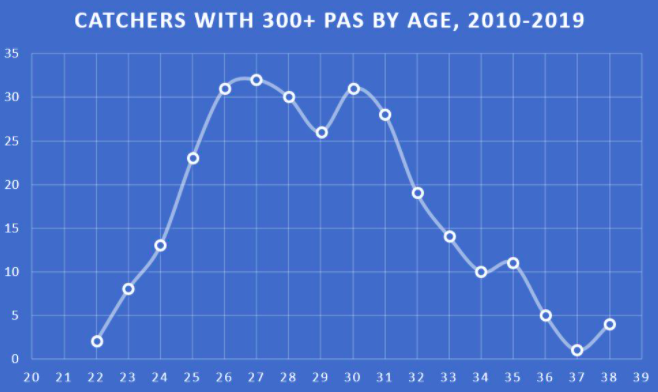
The data shows a peak between the ages of 26-31 with a decline that begins after one’s age-30 season. The decrease is most significant at one’s age-32 season, which would be 2023 for Realmuto.
For an elite catcher like Realmuto though, the Phillies will expect more than 300 plate appearances per season. From 2015-2019, he averaged 543 plate appearances per season.
Here’s a look at the catchers who made the number of plate appearances needed to qualify for the batting title (502 in a full season) from 2010-2019.
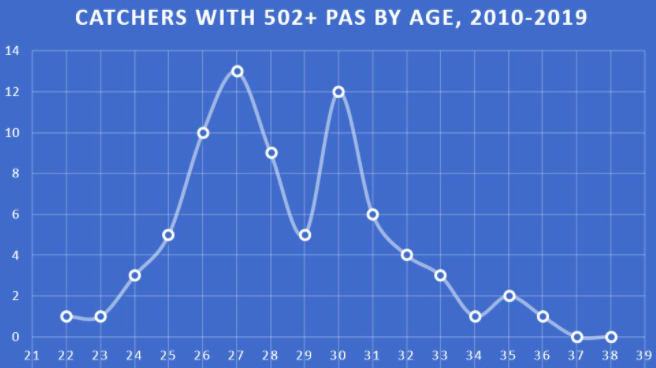
This collection of data shows the peak years for catchers decreases by one year, removing the age-31 season. The number of qualifiers is cut in half from the age-30 to age-31 season.
This seems ominous for Realmuto as he’ll play the first year of his deal at age-30. The good news is that 52 different players in the 2000s played at least 81 games at catcher at 33 or older. That’s more than every position except first base.
The next question is how well those catchers play. Here’s is what the average fWAR for catchers look at each age, again from 2010-2019.
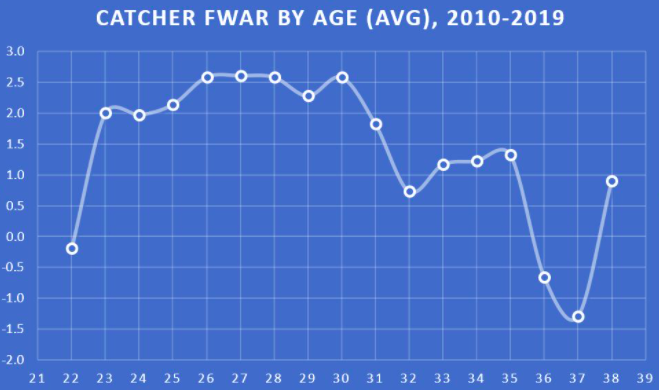
Again, there is a clear peak between the ages of 26 and 30 with a sharp decline in the age-31 season.
It is worth pointing out that Realmuto’s last four seasons are all significantly higher than the averages in each corresponding age group.
- 2017 (age-26 season): 4.4 fWAR
- 2018 (age-27 season): 4.9 fWAR
- 2019 (age-28 season): 5.7 fWAR
- 2020 (age-29 season): 4.6 fWAR (extrapolated from 60 games to 162 games)
Therefore, projecting Realmuto’s viability over the next five years would likely be more accurate if compared to other catchers who performed similarly during their age-26 through age-29 seasons.
Compare Realmuto to 11 other catchers since 1995 (wild-card era) who posted similar numbers in their age-26 through age-29 seasons. The sample here includes Ivan Rodriguez, Brian McCann, Joe Mauer, Russell Martin, Mike Piazza, Jonathan Lucroy, Yadier Molina, Buster Posey, Jorge Posada, Miguel Montero and Charles Johnson.
Those 11 catchers registered the following average fWAR in each of their age-26 through age-29 seasons:
- Age-26 season: 4.8 fWAR
- Age-27 season: 5.5 fWAR
- Age-28 season: 5.3 fWAR
- Age-29 season: 4.5 fWAR
That group on average was a little better in their age-26 and age-27 season than Realmuto was, but slightly worse the next two seasons. This data provides a much better comparison in terms of projecting how Realmuto will age through the length of his contract with the Phillies.
Now here’s a look at those 11 catchers between their age-30 and age-34 seasons, which will be Realmuto’s ago during his final year of the deal.
- Age-30 season: 4.2 fWAR
- Age-31 season: 3.2 fWAR
- Age-32 season: 2.6 fWAR
- Age-33 season: 2.2 fWAR
- Age-34 season: 1.6 fWAR
So, the elite catchers have remained mostly productive through their age-34 season, which is a good sign for the Phillies. There are exceptions of course, as Posada has four of his best seasons from ages 31 to 34. Lucroy, on the other hand, was an above replacement player just once in four seasons since turning 30.
The cost of 1.0 WAR in free agency last offseason was $8.0 million, according to FanGraphs. By that model, if Realmuto performs just to the average level of the elite group, then he will be worth $110.4 million over the next five seasons total. The contract he signed was worth $115.5 million over the next five seasons, so the Phillies pretty much nailed it in terms of finding the optimal value with Realmuto.
Ideally, a club would prefer to sign him to a two or three-year contract since the data shows a catcher’s prime usually ends after his age-31 season, but Realmuto wanted to reset the market for free agent catchers, so three years would likely have been rejected.
Obviously, fWAR projections aren’t always 100% accurate and they are contingent on him staying mostly healthy over the next five years.
However, Realmuto is unusually athletic for a catcher, having registered a sprint speed in the 84th percentile of all players last season. That suggests he won’t completely fall off a cliff physically as he heads into his 30s.
Defense also tends to age well for catchers and Realmuto’s framing was in the 95th percentile among catchers last year, while his pop time has ranked in the top three in each of the last five full seasons, not including 2020.
If MLB decides to implement the universal DH rule, that will also help his longevity by allowing him to stay in the lineup more often without having to catch as much.
If all the data above is any indication, Realmuto likely has two more great years in him. The Phillies should do whatever they can to take advantage of the first couple of years of his contract, but that won’t be easy in a deep National League East division.
The Phillies also now have hefty investments in Realmuto, Harper and Zack Wheeler, so Dombrowski will have to change the club’s poor recent history of drafting and developing, as well as hit on a few smaller signings and trades.
Nevertheless, the Phillies now have arguably the game’s best catcher signed for the next five years. If Realmuto performs even slightly better than the average catcher of his caliber into his 30s, this deal will be well worth the cost.
